
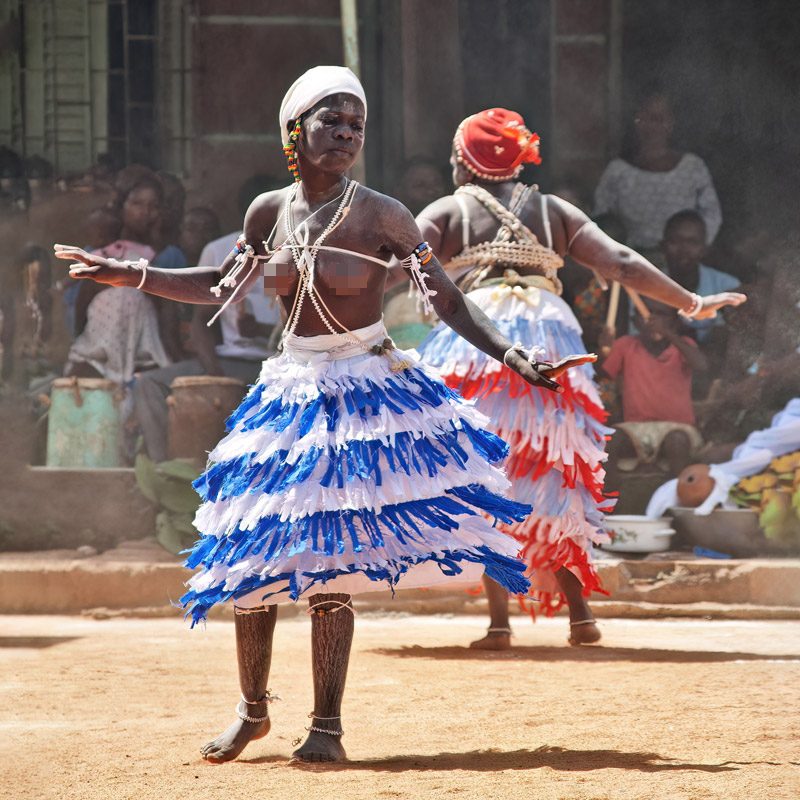
The Anyi ethnographic group (a subgroup of the Akan nation) stretches from Yamoussoukro east to the border with Ghana, with more than 1.2 million members. This tribe of the Ivory Coast use the word ‘Komian’ to refer to trance, that is to say a spiritual possession. This term can also be applied to people and in this case it refers to those people, mainly women, who have been initiated to communicate with the world of spirits. According to tradition, the Anyi tribe Komian priestesses of the Ivory Coast also play the role of healers, resolve conflicts and enthrone the king or tribal chief.

In the city of Aniassue, in the southeast of the Ivory Coast, is the 'Komian School', established in 1992. A symbol of the cultural decadence of African traditional religions in Ivory Coast, the school is slowly deteriorating. Its ochre walls have not been painted for years, and most of its buildings are in disrepair. The course lasts at least three years, with around 20 graduates each year.
People come to the school seeking cures or treatments from the komians for conditions such as cancers, infertility, epilepsy and mental illnesses. Others come for counseling over personal problems.
Do you want to meet the Anyi tribe komian priestesses of the Ivory Coast?
On our next trip to Ivory Coast from 26 December 2025 to 5 January 2026 we will visit the Komian School and spend a night there. Our goal will be to learn about the religion and the unique way of life of the Anyi komian of Ivory Coast. If this culture that is intrinsic to the Anyi people is not supported it could disappear. Click here for more details about the trip.

A dozen women, their bodies coated with clay, sway to beating drums as if in a trance, ankle bells jingling as they stamp their feet, in the school playground. They are training to become certified komian, or priestesses, steeped in traditional lore, the properties of medicinal plants and the techniques of conflict resolution. Also, they are credited with the power to cast spells and predict the future.

One of the main challenges for most African traditional religions is to stop shrinking in favor of Christianity and Islam. One way to empower these unique cosmologies is adapting them to the new times and recognizing them as a national treasure. This has happened in Benin and in some Nigerian regions. At Last Places we believe that visiting these communities, learning about them and supporting them financially through cultural and responsible tourism is giving them respect and helping them a pragmatic way.

© Photos by Aníbal Bueno and Emili Bayona
You can learn more about the Anyi people at www.101lasttribes.com

 ES


