

South Sudan
South Sudan tour:
traditional tribes of Equatoria
2 departures available
Same trip in 2027 and 2028: choose the date that suits you best.
On this South Sudan tour we will live alongside some of the most traditional tribes in the country: the Lotuko, the Larim, the Toposa and the Mundari. We will camp beside their villages and camps to share their daily lives and to understand a worldview that the two civil wars fought in the south of the country, between 1955 and 2005, kept hidden from the rest of the world. We will travel through three ecosystems of South Sudan: the mountains, the bush savannah and the wetlands of the White Nile.
This ethnographic trip to South Sudan comes at a time of change: the country is transforming rapidly, with new roads, NGOs and missions appearing all over the territory. The Last Tribes South Sudan project aims to empower these last tribes through responsible tourism, so that they can protect their identity and, at the same time, decide their own future.
We will travel in a group of 4 to 12 travellers, accompanied by a Last Places guide and an English-speaking local guide. Over 9 days we will cross the country in 4x4 vehicles, combining nights in hotels with camping beside the communities, with camping equipment and a cook. In the detailed itinerary you will find the day-by-day programme, the planned accommodation, the meals included, the length of each transfer and what the price includes. Download the trip itinerary and we will send it to your email address.




Our trip to South Sudan: what we will discover

Juba and Torit: markets at the gateway to Eastern Equatoria
We will begin in Juba, the capital, with a first walk through Konyo Konyo market. We will then head for Eastern Equatoria, the country’s wild frontier, home to its most traditional tribal groups. In Torit, the regional capital, we will explore the central market, among colonial buildings and Pari and Lotuko traders.
The Lotuko kingdom: ancestral authority and vernacular architecture
In the Lafit Mountains we will meet the Lotuko people, who still live on the hilltops. Italian missionaries introduced Catholicism and Western dress in the 1950s, but the essence of their culture remains alive. We will camp in the foothills and visit one of their kingdoms, where we will attend a traditional dance.
The following day we will meet the community leaders. Lotuko society is governed by a tandem: a hereditary queen or king, the ‘rainmaker’, and an age group that changes every 20 to 30 years. We will walk through their villages, which preserve some of the finest examples of vernacular architecture in Africa.
The Boya Hills: scarification and craftsmanship of the Larim people
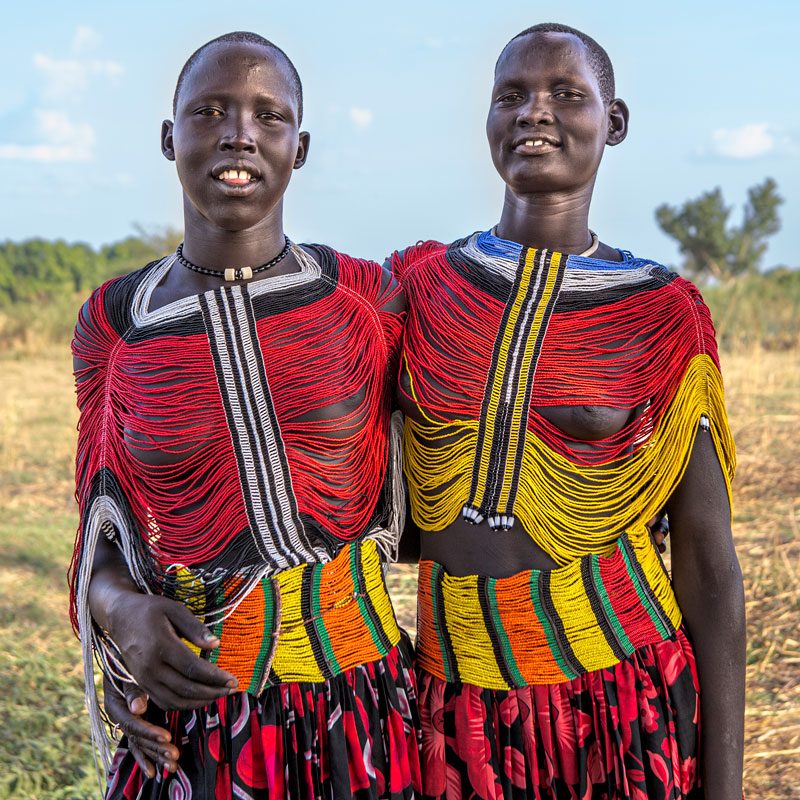
In the Boya Hills we will meet the Larim people, farmers and herders related to the larger Murle nation, who live near the Ethiopian border. Larim women still dress in the traditional way and bear scarification on their faces and bodies. As missionaries remain scarce in the region, there is a deeper connection here with the ancient customs.
We will meet the group of elders and the paramount chief, and walk through villages with remarkable examples of vernacular architecture. We will also discover their fine craftsmanship: headrests, clay and metal pipes, decorated spoons and gourds.

The Toposa plains: cattle herders and scarification
On the way to the plains we will stop at Camp15, a former military base from the war that has become a trading town. Here, Larim and Didinga people from the neighbouring mountains mix with Dinka traders and officials, who have built adobe buildings with decorated façades. At the market in Kapoeta we will see the Toposa gather to trade and bargain.
We will then head into a remote area of the Toposa plains and camp beside one of their villages. The Toposa are cattle herders, famous in East Africa for their cattle raids and their conservative customs. Facial and body scarification is still common among both men and women, and many women still wear goatskins decorated with beads every day.
We will spend two days among the most traditional Toposa, with photography sessions in the villages, a traditional dance and a farewell dance. In the afternoon we will be able to climb a nearby hill to look out over the wooded plains that stretch towards the borders of Uganda, Kenya and Ethiopia: a true last place on Earth. On the way back to Torit, in Kapoeta we will visit a school and a craft workshop.


Mundari cattle camps, the great icon of South Sudan
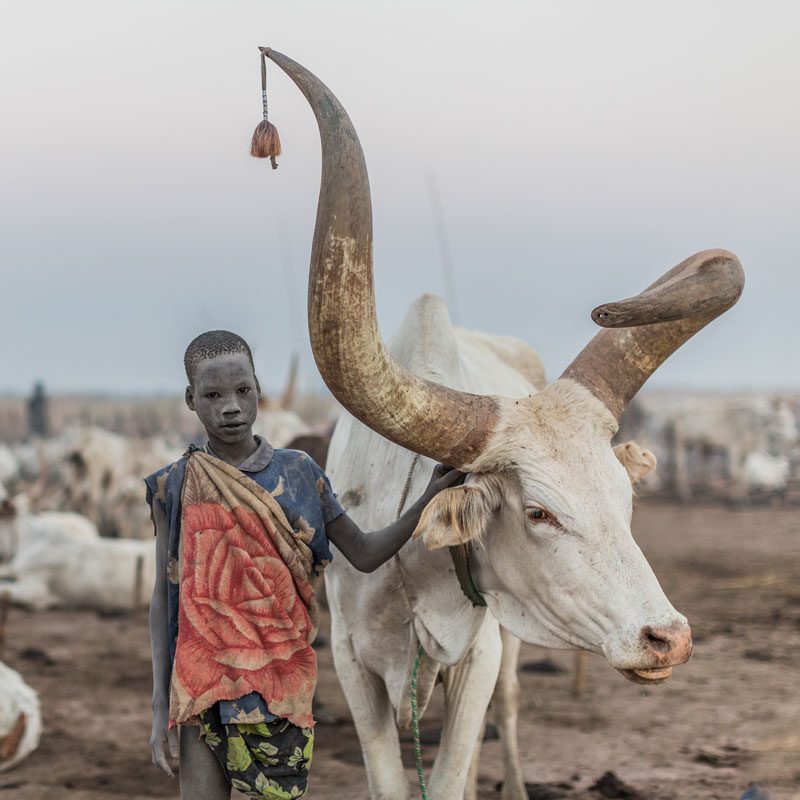
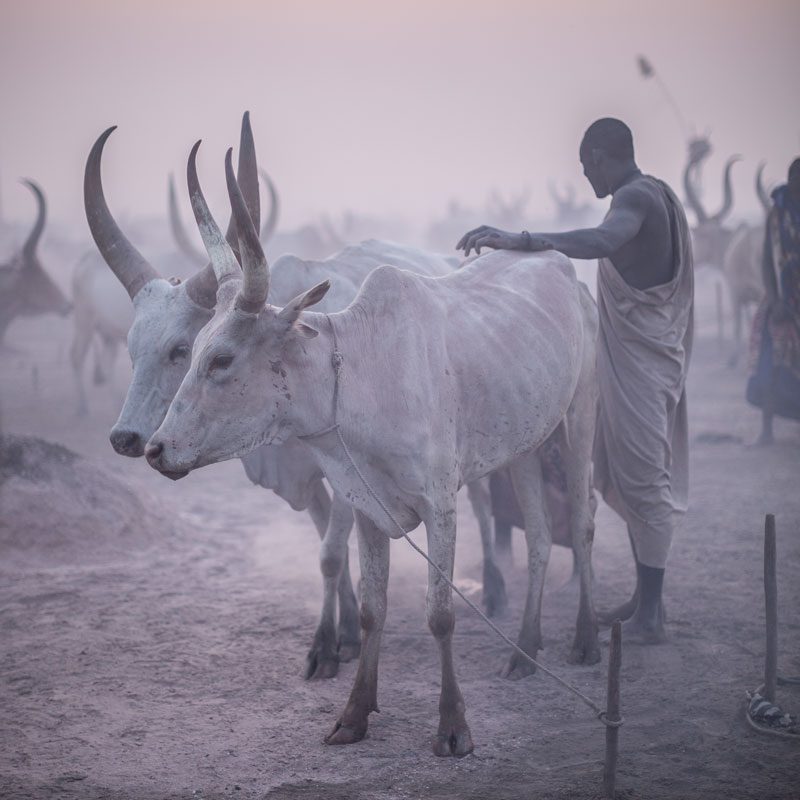
The final stage will take us back to Juba and, from there, to a Mundari cattle camp, probably the most outstanding ethnographic and aesthetic setting in the country. For the Mundari, the camps are what universities are to Western society or monasteries to Buddhist societies. Here, young people aged between 11 and 30 learn how to behave in society and how to relate to their surroundings and to their sacred cattle.
Their long-horned white cows, known as Ankole, are regarded as intermediaries between people and spirits. The older men pass on the customs of the tribe to the new generations until the young men go through the initiation rite and become respected men, eligible to marry. During this ceremony, black and white wooden and metal totems are raised, crowned with the skull of a sacrificed cow.
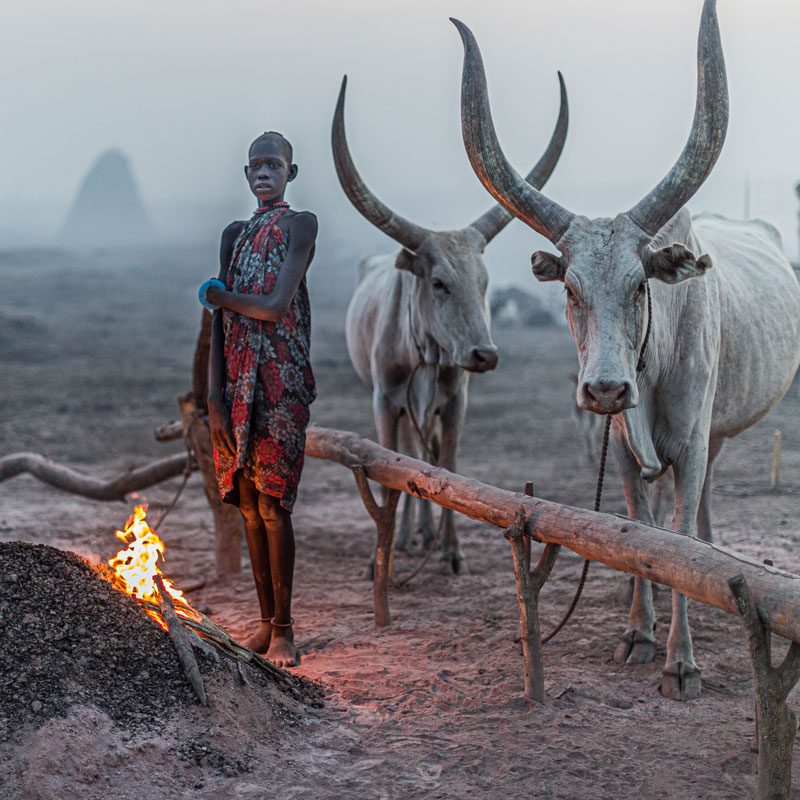
We will camp beside the cattle camp for two days to experience its unique, dusty atmosphere. At dawn and dusk, when the cattle gather around the fires, we will watch their owners clean them, massage them and sing to them. This direct contact with Mundari life will be the high point of our South Sudan tour.
Rituals and daily life in the Mundari cattle camp
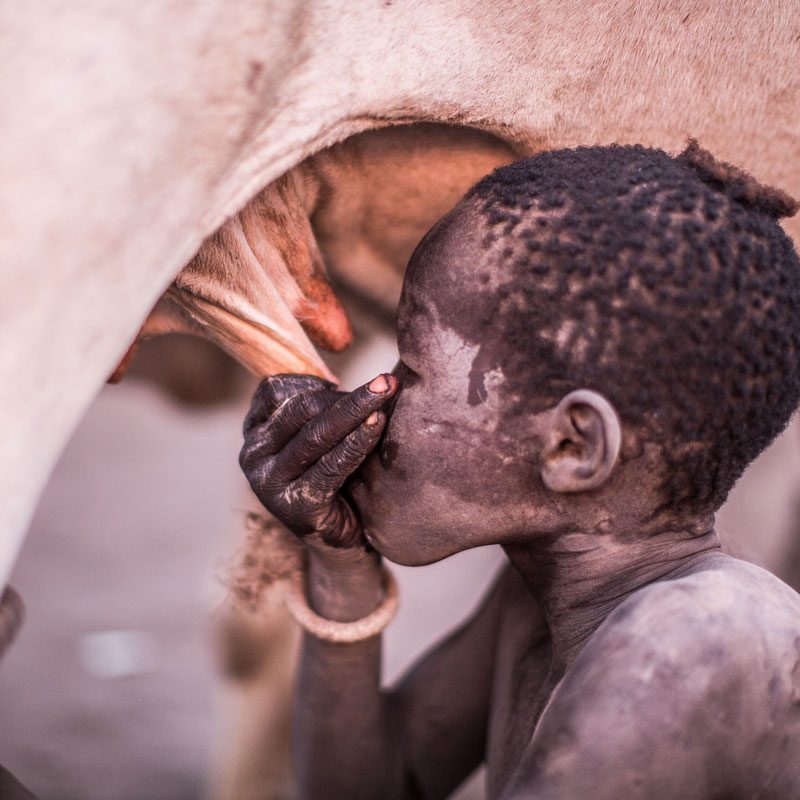
We will wake up early to witness the start of the day’s activity: the songs and massages for the sacred cows, the urine baths and the cleaning of the camp. We will also meet Mundari women and, if it coincides with our dates, we will try to attend a baby-naming ceremony. These practices reflect a worldview in which cattle play a central role in social, spiritual and economic life. In the afternoon, when the young men return with the cattle, we will have our last photography session.
Other peoples along the way: the Dinka and the Didinga
Along the route we are likely to come across people from other groups, such as the Dinka or the Didinga, whom we will see at markets such as the one in Camp15.

Vernacular architecture: villages that are still alive
South Sudan preserves some of the finest examples of vernacular architecture in Africa. Unlike in the rest of the continent, tribal architecture here is still alive, because most tribes still live far from the globalising currents and economic changes that have transformed other African societies. We will see it in Lotuko villages, in Larim settlements and in the decorated façades of Camp15.

© Photographs by Aníbal Bueno, Ana Robles and Jordi Zaragozà, taken during our trips to South Sudan.
Scheduled departures
More trips to Africa
We can also organize your tailor-made trip to . En este caso, indícanos tus intereses mediante el formulario de contacto que encontrarás más abajo.
Get in touch with our experts.

 ES


